Count Masters: Stickman Games
- 4.6
- Rating
- 100.00M
- Installs
- Free
- Price
 Analysis by App-foxy
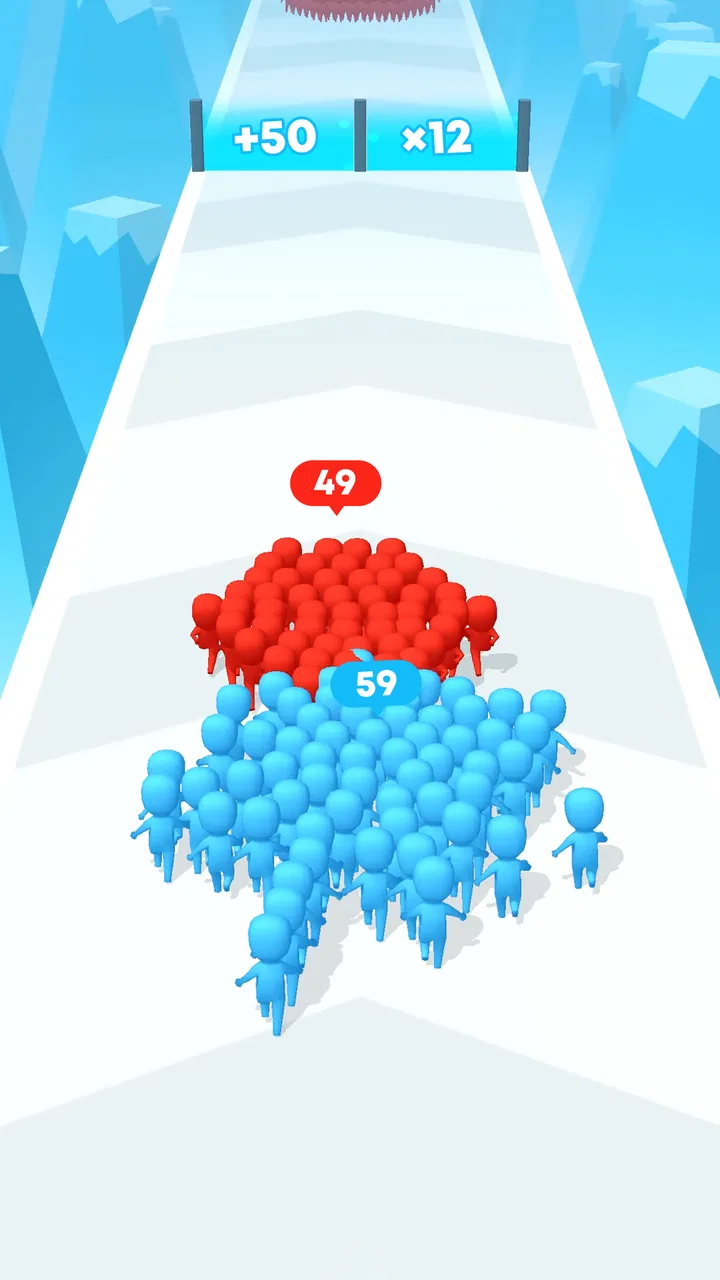
I spent time with Count Masters: Stickman Games as a quick, action-focused runner, and my first impression was clear: this is built around making fast decisions rather than studying complicated controls. You guide a stickman crowd through a series of obstacles, try to grow the group, and aim to reach the finish with enough runners left to handle the final confrontation. The idea is easy to understand within moments, but the best runs still ask you to watch the path carefully and commit to choices before the next gate arrives.
That simplicity is the main reason the game works so well for short sessions. I can open it when I have only a few spare minutes, understand the immediate objective, and begin playing without a long tutorial or a dense menu system. At the same time, it is not completely mindless. A gate that looks attractive at first can lead the crowd into a worse position, while a smaller increase may be safer if it keeps the group aligned for the next obstacle.
How the early goals shape each run
The opening goal is wonderfully direct: build the largest and strongest crowd possible while moving forward. The stick figures run automatically, so my attention stays on steering and choosing between gates or paths. I am not juggling attacks, equipment, dialogue, or a large collection of abilities. The challenge comes from reading the route quickly and deciding whether immediate growth is worth the risk attached to it.
You May Also Like

 Blood Strike: 2.5 Anniversary
Blood Strike’s Loadouts Turn Every Drop Into a Tactical Gamble
A close look at Blood Strike’s custom loadouts: how fast access to signature weapons reshapes its battle royale rhythm, rewards preparation, and narrows the gap between fights.

 Pandora - Music & Podcasts
Pandora’s Music Is Easy to Start, but Harder to Recover
Pandora’s strength is its low-effort path from a seed to a station. Its weak spot is how much confidence it asks you to place in connection, setup, and quiet recovery.

 8 Ball Pool
 Is Built on Rivalries, Rematches, and Routine
A close look at the rivalries, rematches, shared routines, and unanswered safety questions that turn a quick pool match into a persistent mobile community.

 Samsung Music
’s Quiet Strength Is Playing What You Already Own
Its reach comes less from spectacle than from dependable access to a personal library. That simplicity is both the app’s strongest retention engine and its ceiling.

 AccuWeather: Weather Radar
AccuWeather Review: A Quick, Clear Forecast for Everyday Decisions
For everyday plans, the best forecast is the one you can understand quickly. AccuWeather makes rain timing, radar, and local conditions easy to act on, with a few trade-offs.

 Hill Climb Racing
Why Hill Climb Racing Still Turns Crashes Into One More Run
A tiny car, a bumpy hill and one more upgrade: Hill Climb Racing keeps resurfacing because its simple chaos makes every near-miss feel personal.
More From Our News Desk



This creates a useful rhythm. I begin by looking for opportunities to increase the crowd, then shift into protection mode when barriers, gaps, or opposing forces appear. That change in mindset matters because a larger group is not automatically safe. If I take a risky route and lose too many members, the advantage I built at the start can disappear before the finish.
The controls are approachable enough for casual players, but that does not mean every movement feels equally precise. On a small phone screen, quick swipes can sometimes feel more hurried than intended, especially when several visual elements appear close together. I learned to make shorter, earlier movements instead of waiting until the crowd was almost touching an obstacle. That small adjustment made my runs more consistent.
For a new player, I recommend treating the first attempts as route-reading practice rather than chasing a perfect result. Watch how the crowd responds to movement, notice which choices create awkward positioning, and learn when the safest lane is more valuable than the most ambitious one. This is one of the first non-obvious lessons in the game: the best gate is often the one that preserves momentum, not simply the one with the biggest visible reward.
Why the first few minutes feel approachable
The game communicates its core loop visually. The crowd grows or shrinks in front of me, and the consequences of a choice are immediate. I do not need to inspect a spreadsheet of statistics to understand whether a run went well. More stick figures usually means I am in a better position, while a sudden reduction tells me that my route choice or timing needs work.
That clarity makes it suitable for people who prefer action games with very little setup. It is also a reasonable choice for younger players within its Everyone 10+ content rating, although I would still expect the difficulty and repeated attempts to matter more to some players than others. The presentation is playful rather than realistic, and the stickman style keeps the action readable even when the crowd becomes busy.
One everyday use case fits it particularly well. If I am waiting for a coffee, sitting on public transport, or taking a short break between tasks, I can play one or two runs without needing to remember a complicated story. The game gives me an immediate target, a visible result, and a natural stopping point. It does not demand the kind of uninterrupted attention that a long strategy match or narrative adventure usually requires.
Progress signals and the satisfaction of improvement
What kept me interested was not only winning individual runs. I also enjoyed noticing that familiar routes became easier once I understood their rhythm. The progress signal is mostly practical: I make better choices, keep more of the crowd together, and reach the later parts of a run with greater confidence. That kind of improvement feels earned because it comes from observation and timing rather than from memorizing a complicated control scheme.
The crowd itself is the clearest feedback system. It acts as both my resource and my visual score. When I enter a section with a healthy group, I feel free to take a calculated chance. When the crowd has been reduced, I become more conservative and start prioritizing survival. This makes every loss meaningful without requiring the game to explain a long list of numbers.
The finish also gives each attempt a satisfying shape. I am not merely trying to survive until the screen ends; I want to arrive with enough strength to deal with what waits at the end. That final pressure changes how I evaluate earlier decisions. A move that looks successful halfway through may be a poor trade if it leaves too few runners for the closing encounter.
My practical advice is to judge a run in stages. First, ask whether the crowd is growing. Next, ask whether it is staying together through hazards. Finally, consider whether the remaining group is strong enough for the finish. This three-step check prevents a common mistake: celebrating early growth while ignoring the damage caused by later positioning.
The game’s broad popularity is easy to understand. It is free, has passed over one hundred million installs, and holds a 4.6 average from around seven hundred thirty-one thousand ratings. Those figures do not guarantee that every player will enjoy it, but they do reflect how accessible the central idea is. The large audience also suggests that its quick, visual loop travels well across different kinds of mobile players.
Unlocks, variety, and what progress does not solve
Progress in this kind of game is most convincing when it changes how I approach the next attempt. Reaching a new stage or seeing a new obstacle can provide that spark, because I have to adjust rather than repeat the exact same movement. The feeling is strongest when a new section asks me to balance crowd growth against safety in a slightly different way.
However, players who need deep character development, a detailed upgrade tree, or a long-term competitive system may find the progression light. The appeal is in the immediate run and the gradual improvement of my decisions. It is not the right substitute for a full action role-playing game, a tactical battler, or a runner focused on extensive customization.
I also found that visible progress can lose some of its impact when repeated attempts begin to feel familiar. The early stages are excellent for learning the basics, but experienced players may want more substantial variation than a compact runner naturally provides. That is not a flaw for a short-session game, though it does define the audience: I would recommend it more readily to someone who enjoys polishing execution than to someone who expects a constantly expanding system.
Difficulty curve: when simple choices become demanding
The difficulty feels gentle at first because the objective is so readable. I can concentrate on moving the crowd and identifying obvious opportunities. As the route becomes more demanding, the margin for recovery narrows. A poor decision is not always fatal immediately, but it can weaken the group enough that the next obstacle becomes much harder to handle.
This gradual pressure is more interesting than simply making everything faster. I have to plan one decision ahead. If I move toward a gate too late, I may miss it; if I change direction too sharply, I may create a poor line through the next obstacle. The game rewards anticipation, especially when the crowd is large and the screen becomes visually crowded.
There is also a trade-off between aggressive and patient play. Aggressive routes can produce a bigger crowd and a more satisfying finish, but they leave less room for error. Patient routes may feel less exciting, yet they are often the better option when I am learning a new section. I would not call the safest choice boring; it gives me a chance to understand the layout before attempting a more ambitious run.
One useful technique is to stop treating every gate as an isolated decision. I look at the next visible hazard before choosing the current route. If a growth option positions the crowd badly for what follows, I may accept a smaller gain. This is a specific strength of the design: the game turns arithmetic-looking choices into spatial decisions, so the result depends on both the number of runners and where they end up.
Where the challenge can become frustrating
The same immediacy that makes the game accessible can also make mistakes feel abrupt. When I misread a route, there may be little time to correct it. Players who dislike restarting after a short error may find this repetitive, particularly if they prefer games that allow recovery through defensive tools or multiple forms of strategy.
Touch control is another factor. I generally found it easy to understand, but precision depends on the phone and on how carefully I move. A crowded screen can make it harder to distinguish the exact space I want the group to occupy. Playing with a clean view of the screen and using deliberate swipes helped more than making frantic corrections.
The game is best enjoyed when I accept that failed runs are part of the loop. If I expect every attempt to produce steady progress, the repetition may become irritating. If I use each failure to identify one specific mistake—poor timing, an overly risky gate, or a bad approach to the final section—the restart feels more purposeful.
Retention pressure and the cost of “just one more run”
The strongest retention tool here is the short, repeatable structure. A run ends quickly enough that I can immediately see how a different choice might have changed the result. That creates a natural temptation to try again, especially after losing a large crowd near the finish. The game does not need a complicated narrative hook when the route itself gives me an obvious unfinished challenge.
That loop can be enjoyable, but it can also become repetitive. I would be cautious about recommending it to someone who wants a single, substantial session with a clear conclusion. It is better for players who like incremental mastery: improve one decision, survive one more obstacle, and gradually become more comfortable with the pacing.
The free price makes trying it easy, while in-app purchases are listed at $2.99 per item. I personally think the sensible approach is to begin without spending and decide whether the basic loop is enough for you. A purchase should only make sense if it addresses a convenience you genuinely value; it should not be treated as a requirement for understanding or enjoying the central crowd-running challenge.
Because the game is free, I also recommend setting a simple personal limit before starting a long session. The “one more attempt” feeling is strongest after a near miss, and that can turn a short break into a much longer one. For me, the best use is a handful of runs followed by a pause, rather than leaving it open indefinitely in the background of the day.
The age rating of Everyone 10+ is useful context for families deciding whether it fits a shared device. The action is stylized and easy to read, but the repeated failure-and-retry structure may appeal differently to each player. A child who enjoys quick goals may find it engaging, while someone who becomes frustrated by losing a crowd may need encouragement to view each attempt as practice.
Who should choose it, and who should skip it
I would recommend it to players who enjoy simple controls, visible consequences, and short action sessions. It is especially good for anyone who likes the satisfaction of turning a small group into a large one, then protecting that advantage through a sequence of quick decisions. It also works for people who want a game that can be understood immediately without giving up all room for judgment.
I would skip it if your priority is deep customization, a persistent story, complex combat, or a detailed multiplayer experience. A more traditional endless runner may suit you better if you want score chasing with constant speed and reflex pressure. A strategy game may be the better choice if you want to pause, examine several options, and plan without a moving crowd forcing the decision.
Compared with those alternatives, this game sits in a middle ground. It has the instant accessibility of a casual runner, but its crowd management gives each route choice more weight than a simple lane-switching game. It is less demanding than a full action title, yet more decision-oriented than an experience where the main goal is merely to avoid obstacles for as long as possible.
My progression verdict after repeated runs
For me, the progression works best when I focus on the changing demands of each route rather than expecting a huge collection of long-term systems. Early goals are clear, progress is visible through better crowd preservation, and the difficulty grows by reducing the room for careless choices. The pacing is strongest in short bursts, where each attempt gives me one practical lesson to carry into the next.
The main limitation is that the same compact design can eventually feel narrow. Once I have learned the basic logic of growing the crowd, positioning it, and arriving prepared for the finish, the lasting appeal depends heavily on whether I enjoy repeating that loop. Players seeking constant novelty may move on sooner than players who like refining a familiar skill.
Freeplay Inc has made a game that understands the value of immediate feedback. I always know whether my crowd is healthy, whether a route was too risky, and whether I reached the end in good shape. The current version is 1.99.3, and the game supports devices running Android 7.0 or later, which makes it approachable for many mobile users.
My final recommendation is positive, with a clear condition: try it if you want a colorful, quick action runner built around crowd decisions, but do not expect it to replace a deep strategy or combat game. I like how quickly it gets to the point, and I appreciate that successful runs come from reading the path rather than simply holding a button. Count Masters: Stickman Games is at its best when I treat every attempt as a small experiment: grow when the route supports it, protect the group when the path turns dangerous, and save enough strength for the moment that decides the run.
FAQs for Count Masters: Stickman Games
01What is the main objective of Count Masters: Stickman Games?
Count Masters: Stickman Games is a fun and engaging game where players guide a group of stickmen through various obstacles. The main objective is to increase your stickman army by passing through gates with different numerical values, often requiring strategic planning to maximize your count and overcome challenges.
02How do I control my stickman army in the game?
Players control their stickman army using simple swipe gestures on the screen. Swiping left or right directs the group to move in that direction. The intuitive controls are designed to be easy to learn, allowing players of all ages to quickly get the hang of guiding their stickmen through the levels.
03Are there in-app purchases in Count Masters: Stickman Games?
Yes, Count Masters: Stickman Games offers in-app purchases. These can include items such as power-ups, skins, and other enhancements to improve gameplay. While the game is free to download and play, these optional purchases can enhance the gaming experience and help players progress more quickly.
04Is an internet connection required to play Count Masters: Stickman Games?
Count Masters: Stickman Games can be played offline, making it a great choice for gaming on the go. However, certain features, such as updates or access to leaderboards, may require an internet connection. Playing online also ensures you have the latest version of the game with all available features.
05What age group is Count Masters: Stickman Games suitable for?
Count Masters: Stickman Games is suitable for players of all ages, though it is particularly popular among children and younger audiences due to its simple controls and colorful graphics. The game’s content is family-friendly, making it an excellent choice for casual gaming sessions.
Pros
- Engaging level design keeps players hooked.
- Simple controls make it easy to play.
- Vibrant graphics enhance visual appeal.
- Regular updates introduce fresh content.
- Free to play with optional in-app purchases.
Cons
- Ads can be intrusive during gameplay.
- Game mechanics become repetitive over time.
- In-app purchases may become necessary.
- Requires internet connection for some features.
- Limited customization options for characters.

Count Masters: Stickman Games
Gallery